
Why do people decide to bring a purebred dog into the family?
Why a purebred dog means not only looks but also a predictable character. On the role of temperament, the breeder’s responsibility and the importance of choosing the right puppy.
Category: Cynology education
First and foremost – because of its predictability. This allows future owners to rely on the characteristics they learned about in advance and, consequently, on a harmonious and comfortable life together.
What really matters more – a well-socialised, breed-typical temperament, or outward effect: eye colour, topline, coat colour?
In today’s conditions we cannot neglect the former. It is precisely a stable, breed-typical temperament that makes life with a dog safe, predictable and fulfilling, and that reduces the risk of the animal being abandoned because of unwanted behavioural traits.
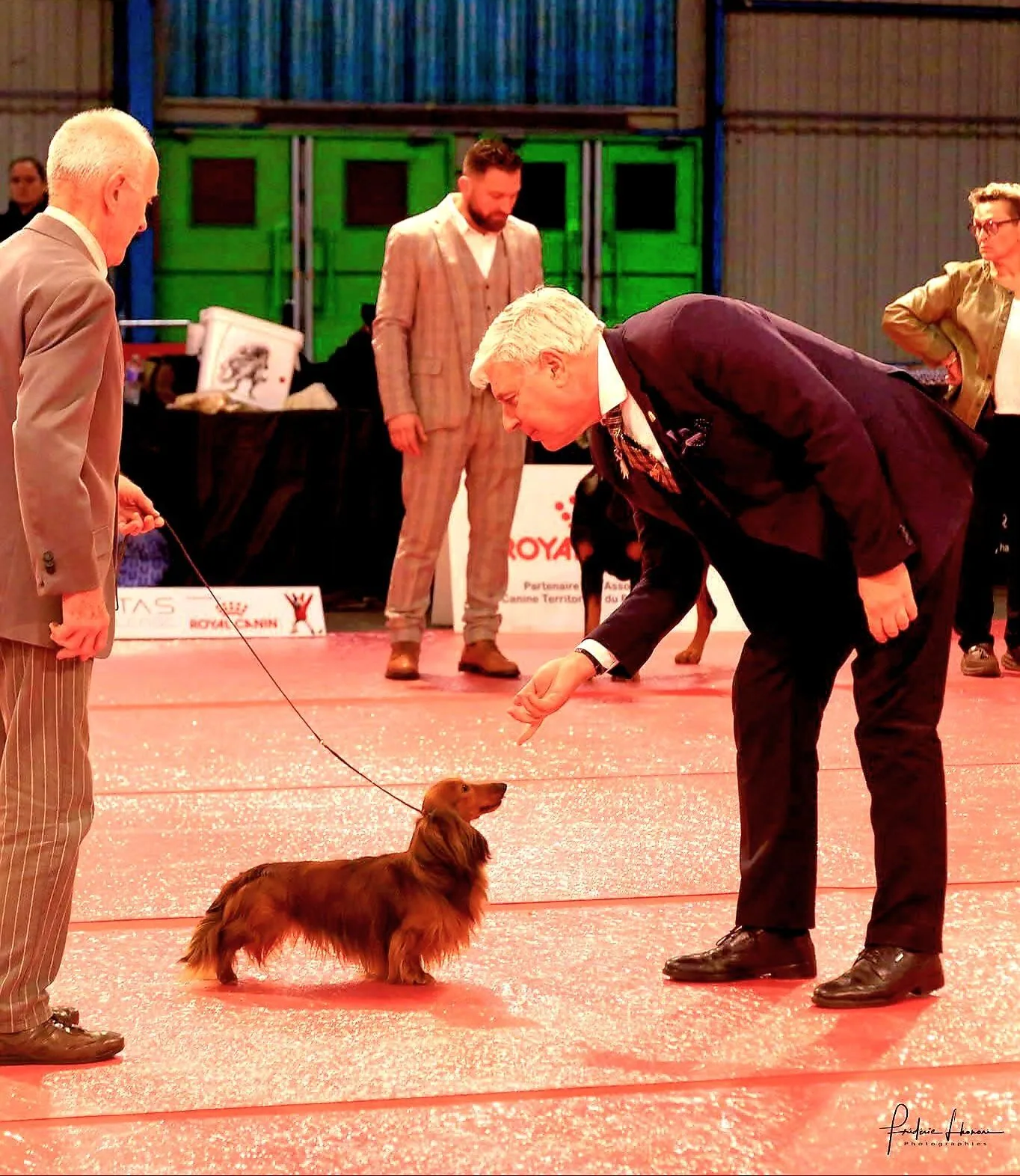
Judging at a dog show makes it possible to assess the basic temperament – whether it matches the breed type – drawing on the judge’s experience and professional competence. At the same time, the ways in which temperament shows itself vary from breed to breed.
Taking my own breed – the Dachshund – as an example, I use a simple basic test that I apply constantly in practice. I attract the dog’s attention and lower my hand neutrally in front of it without making contact, as if offering myself for interaction.
The Dachshund is not one of the breeds with a universally friendly attitude towards strangers, but it does show interest in the world around it. The ideal reaction is to stay calm, then come up, check or sniff the hand and return to its starting position.
This can be interpreted as: “You’re not my person, but I’ve checked – everything’s fine.”
If the dog shows obvious friendliness and good socialisation – wagging its tail or seeking contact – this is acceptable, but it is not required of this breed on first meeting an unfamiliar person.
At the same time, if the dog shows fear or panic, tries to hide behind the handler or displays unjustified aggression without any provocation, this is atypical behaviour. In such cases, whatever the merits of its conformation, the dog cannot be graded “Excellent”.
I cannot mislead the future owners of its offspring. Such dogs must not be used for breeding.
My many years of experience in breeding various breeds confirm that both temperament and deviations from it are hereditary and are passed on to the next generations. This is an important part of the responsibility of both the breeder and the judge.
Of course, even a genetically determined temperament cannot develop fully without proper socialisation during the critical period – from 6 to 12 weeks and beyond.
That is why the breeder’s key task is to work actively with the puppies during this period and to choose their owners deliberately, taking into account each puppy’s individual traits.
Author: Dr Tamás Jakkel
President of the Fédération Cynologique Internationale (FCI)
Translation and adaptation: Educational Cynological Centre of Moldova
Source: the author’s official page on Facebook
Share on Facebook (opens in a new tab)
All news