
Ministry of Environment clarifies how hunting dog passports are recognized and when dogs may take part in hunts
Moldova’s Ministry of Environment has clarified that a hunting ground manager cannot require a dog to be registered again or exclude it from a hunt solely because another hunting association lawfully issued its passport.
Category: Official information
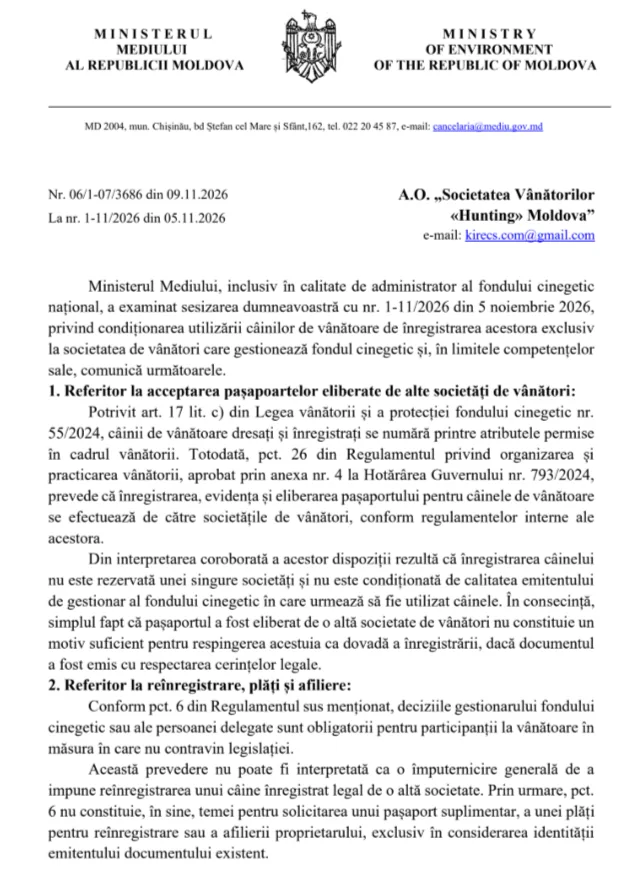
Following a statement by the Society of Hunters and Anglers of Moldova that only dogs registered with the Society may take part in hunts on the hunting grounds it manages, we are publishing the official response from the Ministry of Environment of the Republic of Moldova to an inquiry from the “Hunting” Moldova Hunters’ Association.
In its letter, the Ministry clarified the legal provisions governing the recognition of hunting dog passports, the re-registration of hunting dogs and their participation in hunts. It also clarified the limits of the authority of organizations that manage hunting grounds.
The Ministry of Environment, including in its capacity as administrator of the national hunting fund, has reviewed your submission No. 1-11/2026 of 5 November 2026 concerning whether hunting dogs may be used on a hunt only if they are registered with the hunters’ association that manages the hunting ground in question. Within the scope of its authority, the Ministry provides the following response.
1. Acceptance of passports issued by other hunters’ associations
Under Article 17(c) of Law No. 55/2024 on hunting and the protection of the hunting fund, trained and registered hunting dogs are among the means permitted for use in hunting. Paragraph 26 of the Regulation on the organization and conduct of hunting, approved by Annex No. 4 to Government Decision No. 793/2024, provides that hunters’ associations register hunting dogs, keep records and issue hunting dog passports in accordance with their internal rules.
Read together, these provisions establish that no single hunters’ association has the exclusive authority to register a dog. Registration does not depend on whether the association issuing the passport manages the hunting ground where the dog is to be used.
Consequently, the fact that another hunters’ association issued the passport is not, in itself, sufficient grounds to reject it as proof of registration, provided that the passport was issued in accordance with legal requirements.
2. Re-registration, fees and membership in a hunters’ association
Under paragraph 6 of the above Regulation, decisions made by the manager of the hunting ground or by a person acting under the manager’s authority are binding on participants in the hunt insofar as those decisions are consistent with the law.
This provision cannot be interpreted as granting a general power to require the re-registration of a dog lawfully registered by another hunters’ association. Accordingly, paragraph 6 does not, in itself, provide a legal basis for requiring the owner to obtain an additional passport, pay a re-registration fee or join the association solely because another organization issued the existing passport.
3. Participation in a hunt
A hunting permit and a hunting dog’s passport serve distinct legal purposes. The permit entitles the holder to hunt on the hunting grounds managed by the issuing organization, subject to the conditions laid down by law. The dog’s passport serves as proof of registration and records the dog’s details.
Possession of the passport does not confer an unconditional right to use the dog in any given hunt. However, where the requirements applicable to the participant, the dog and the hunt in question are met, any refusal to allow the dog to participate must be based on specific, verifiable grounds. The issuing organization’s affiliation with another hunters’ association is insufficient on its own.
4. Checks and record-keeping for individual hunts
Verifying that the passport is authentic, that its details match the dog presented and that the applicable requirements have been met does not amount to requiring the owner to re-register the dog.
The dog’s details may be entered in the records for a particular hunt to help organize the hunt and identify the participants and the dogs taking part. Such record-keeping cannot be used to require the owner to obtain another passport solely because of who issued the existing one.
Any restrictions must be justified by specific circumstances, such as discrepancies in the dog’s identification details, failure to meet the applicable requirements or documented risks to the conduct of the hunt.
5. Alleged unjustified obstruction of hunting
Whether Article 13(14) of Law No. 55/2024 applies must be assessed in light of the circumstances of each case. This requires establishing the conditions under which the person was to take part in the hunt, the reasons for the refusal, who made the decision and what consequences it had.
The public statements cited may be relevant to the assessment of the case. Determining whether a violation occurred and whether any liability arises requires considering those statements alongside the decision in question, the hunting ground manager’s explanations and the other available evidence.
6. Recognition of hunting dog passports
The provisions examined do not establish a separate procedure for each hunting ground manager to approve or recognize passports lawfully issued by other hunters’ associations. The authority to verify an individual document does not confer a general power to invalidate documents issued by other organizations.
7. Challenging a refusal
To document a refusal, the person concerned may ask the hunting ground manager to provide, in writing, the reasons for the refusal and the grounds on which it was based. When bringing the matter before the competent authority, it is helpful to provide copies of the dog’s passport, the hunting permit and either the refusal or the related correspondence, together with details of the date, the place and the person who ordered the measure.
The competent authority, the procedure for challenging the refusal and the applicable time limit depend on the act being challenged and the nature of the legal relationship. An association’s status as a hunting ground manager is not, in itself, sufficient to classify every refusal it issues as an administrative act.
Conclusion of the Ministry of Environment
In light of the above, the Ministry considers that the identity of the association that issued the passport does not, in itself, justify rejecting a lawfully issued passport or requiring the dog to be registered again. Assessing the legality of a particular decision and determining the appropriate measures requires examining the decision itself, the reasons given and how it was applied in practice.
In carrying out its duties to organize and conduct hunts, the hunting ground manager may, within the applicable legal framework, set conditions for the use of dogs in a particular hunt and decide whether to admit them. In making that decision, the manager may take into account the target species, the hunting method, the registration and identification of the dogs, and the need to ensure the safety of participants and protect wildlife. This discretion is limited. Under paragraph 6 of the Regulation on the Organization and Conduct of Hunting, approved by Annex No. 4 to Government Decision No. 793/2024, the manager’s decisions are binding only if they are consistent with the law.
Possession of a lawfully issued passport therefore does not confer an unconditional right to use the dog in any hunt. Any refusal to admit the dog must, however, be based on objective, verifiable grounds related to the circumstances of the particular hunt. The fact that another hunters’ association registered the dog and issued its passport is insufficient, on its own, to justify a refusal.
Minister of Environment
Gheorghe HAJDER
Share on Facebook (opens in a new tab)
All news