
Clinical BOAS testing – a first for international dog shows in Chișinău
BOAS testing for brachycephalic breeds at RELAX DOG FEST 2026 (Chișinău, Moldova)
Category: News
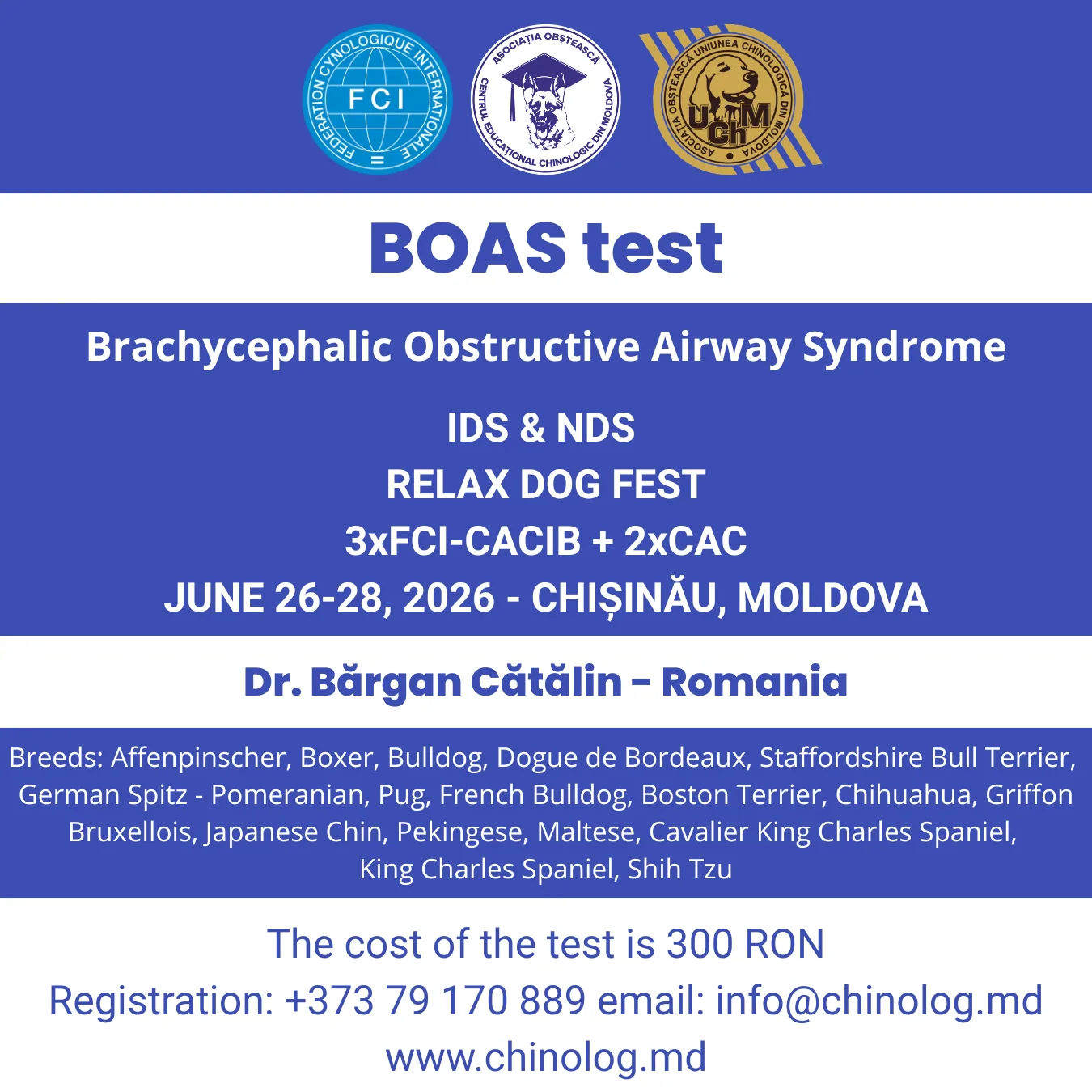
As part of the international and national dog shows RELAX DOG FEST 2026 (3xFCI-CACIB + 2xCAC), to be held on 26–28 June 2026 in Chișinău, clinical testing of dogs for brachycephalic obstructive airway syndrome (BOAS) will be organised for the first time.
The testing will be carried out by a certified veterinarian: Dr Bărgan Cătălin (Romania)
What is BOAS?
BOAS (Brachycephalic Obstructive Airway Syndrome) is a complex pathological condition characteristic of brachycephalic dog breeds and associated with an anatomical narrowing of the airways.
In brachycephalic dogs, the shortening of the facial part of the skull is often not accompanied by a proportional reduction in the volume of the soft tissues of the upper airways. This leads to narrowing of the nasal cavity and partial obstruction of the pharynx and larynx.
The condition may present with the following clinical signs:
- laboured and noisy breathing
- stenotic nares (narrowed nostrils)
- reduced stamina and exercise intolerance
- heat intolerance
- breathing disorders during sleep (including obstructive apnoea)
- gastrointestinal disorders (vomiting, regurgitation)
In severe cases the following may occur:
- cyanosis (bluish discolouration of the mucous membranes)
- collapse
BOAS is a progressive condition that directly affects the dog’s quality of life and its suitability for breeding.
Why is the testing carried out?
The BOAS test is an objective clinical assessment of respiratory function that:
- establishes how severe the problem is
- gives breeders a basis for responsible mate selection
- meets international veterinary standards
- helps to improve the health of the breeds
Breeds taking part in the testing
The testing is carried out mainly for brachycephalic breeds:
Affenpinscher, Boxer, Bulldog, Dogue de Bordeaux, Staffordshire Bull Terrier, German Spitz (Pomeranian), Pug, French Bulldog, Boston Terrier, Chihuahua, Griffon Bruxellois, Japanese Chin, Pekingese, Maltese, Cavalier King Charles Spaniel, King Charles Spaniel, Shih Tzu.
Test methodology
The assessment follows the international scheme (RFG Scheme) and includes:
- Auscultation of the dog’s breathing at rest
- An exercise test (3 minutes of active movement)
- Re-assessment of breathing after exercise
Based on the results, the dog is assigned a grade from 0 to 3:
- 0 – clinically healthy
- 1 – mild signs
- 2 – moderate signs (monitoring required)
- 3 – marked impairment (treatment and exclusion from breeding are recommended)
How often should a dog be examined?
Because BOAS is a complex and progressive syndrome, its severity can change over the course of the dog’s life.
The assessment is therefore recommended:
- from the age of 12 months
- and then repeated every 2 years
The examination should be carried out throughout the animal’s life or until it is no longer used for breeding.
Results and certificate
After the testing, the owner receives an official assessment report, which can be used:
- in breeding work
- in mate selection
- as proof of the dog’s health status
Cost of testing (certificate included): 300 RON
Registration:
+373 79 170 889
info@chinolog.md
www.chinolog.md
Share on Facebook (opens in a new tab)
All news